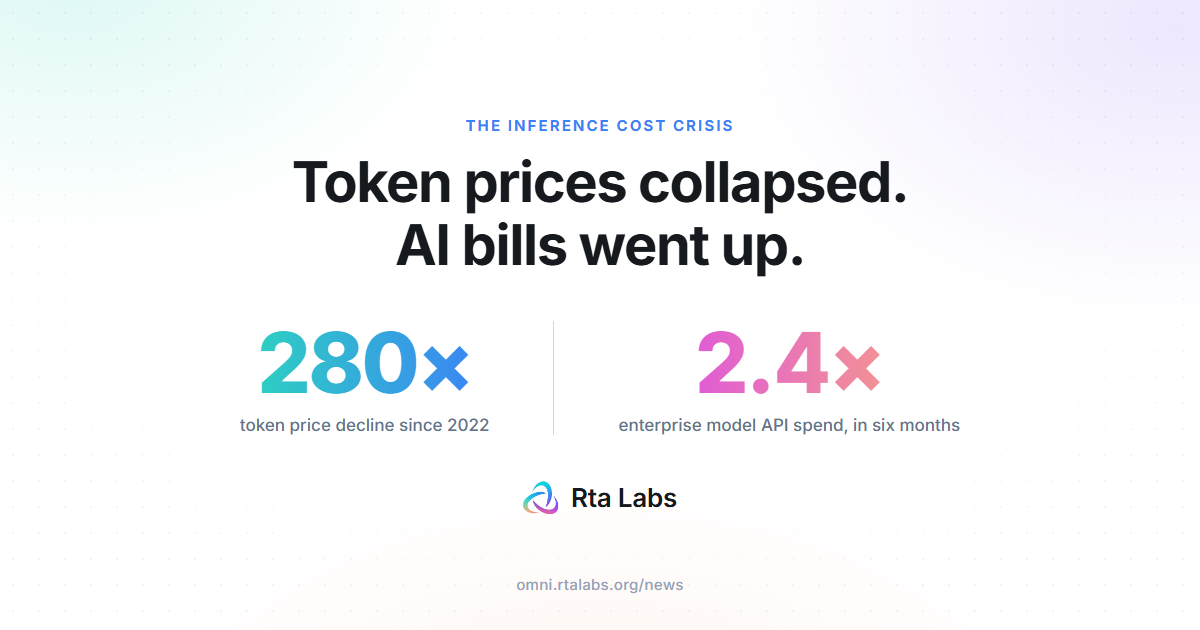
Here's the strangest chart in enterprise software right now. The cost of querying a model at GPT-3.5 level fell from $20.00 to $0.07 per million tokens between November 2022 and October 2024. That is a 280-fold collapse in two years (Stanford AI Index 2025). Over roughly the same stretch, enterprise spend on model APIs more than doubled in six months, from $3.5 billion to $8.4 billion (Menlo Ventures).
Prices collapsed. Bills exploded. Both are true, and the reason matters more than either number.
Why do AI bills rise while token prices fall?
A chatbot answers a question in one round trip. An agent works: it plans, calls tools, reads the results, and iterates. Every step of that loop is another metered call, and the industry moved from chatbots to agents in the same window that prices fell.
Our analysis: agentic cost multiplies three ways, not one
We run agentic workloads in production, and the token math has a structure that the headline numbers hide. Cost multiplies along three independent axes:
- Run cadence. Humans ask questions at human speed. Automation runs at machine speed. A workflow on a five-minute schedule executes roughly 8,600 times a month, whether or not anyone is watching.
- Calls per run. An agent that uses tools makes several model calls per task, not one.
- Context growth inside a run. Each tool step re-sends the conversation so far plus the tool output. By our measurements a six-step agentic run costs closer to 15 to 20 times a single call, not 6 times.
Multiply the three and you get the answer to this article's title. Per-request pricing plus agentic workloads means cost scales with success: the more work your agents do, the more you pay, linearly, forever. A deployment that works twice as well costs twice as much. Price cuts soften the slope. They cannot change its shape. Only architecture can.
Why can't most teams see it coming?
Because the bill arrives aggregated. Spend lands as one provider invoice, usually reconciled in a spreadsheet, so almost nobody can answer the one question that matters operationally: what does one processed invoice, claim, or ticket cost us?
What fix does the cost data point to?
Look at where the money goes and the shape of the fix follows. The spend that doubled is per-request frontier calls doing high-volume, repetitive work: classification, routing, extraction, triage. That work does not need a frontier model per request. It needs a small model that knows the task, with a frontier model held in reserve for the cases that are genuinely hard. Stop sending routine work to a per-request frontier model at all.
That architecture is what OMNI is
OMNI productizes exactly that pattern, end to end. A compact specialist trained on your own documents and conventions resolves the routine majority of requests locally, at near-zero marginal cost, inside your deployment. Only genuinely uncertain cases escalate to a frontier model for review.
On our published benchmarks that lands at 13 to 82 times lower cost per million requests than per-request frontier calls on the same tasks, with 87.2% to 98.2% of requests resolving locally with no frontier fees. We publish the losses next to the wins: the specialist was more accurate in two of three domains, and the frontier model led by 4.3 points on the third while costing 13 times more per request (methodology and results).
Notice how the specialist attacks all three multipliers at once. Cadence still happens, but each run resolves locally instead of hitting a metered API. Tool loops still happen, but against a model with near-zero marginal cost. And context stays disciplined because the specialist is trained on the task rather than prompted into it.
The teams this matters most for are the ones already succeeding. If your AI feature works and your margin shrinks because of it, you have an architecture problem with a known fix.
If you can't currently say what one processed document costs you, that's the place to start. It's a half-day measurement, and it makes every decision after it obvious. We're happy to help, or find OMNI on Google Cloud Marketplace. This article is part of a series: we've covered why 95% of enterprise AI pilots fail.